
A guide to choosing ZEISS prescription lenses from eyeglasses
A guide to choosing ZEISS prescription lenses from eyeglasses
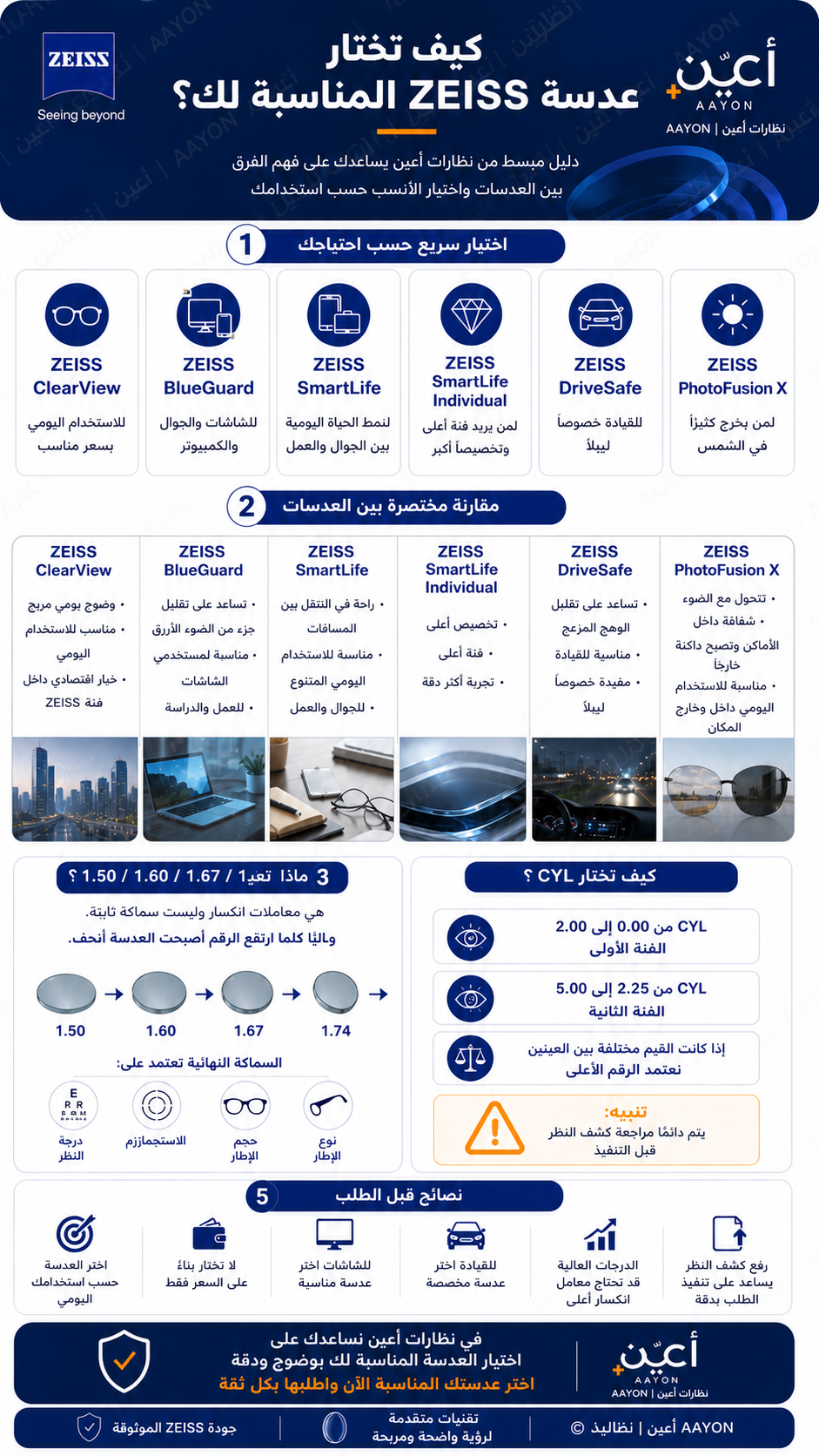
Choosing a medical lens depends not only on the name, but also on your daily use, eye exam, degree of astigmatism, frame type, and whether you need a daily lens, for screens, for driving, or for the sun.
At Eyeglasses, we have prepared this guide for you so that you can choose the right ZEISS lens for you clearly, without complications and without confusing terms.
How do you choose the right ZEISS lens for you?
If you want a clear daily lens at an affordable price:
Choose ZEISS ClearView
If you use your mobile phone and computer a lot:
Choose ZEISS BlueGuard or ZEISS SmartLife depending on your needs.
If you drive a lot, especially at night:
Choose ZEISS DriveSafe
If you spend a lot of time outdoors in the sun and want a lens that changes with the light:
Choose ZEISS PhotoFusion X
If you want a higher-class everyday lens with more customization:
Choose ZEISS SmartLife Individual
If you have high vision and are afraid of the lens thickness:
Choose a higher refractive index depending on the prescription and frame, such as 1.60, 1.67, or 1.74, whichever is most suitable for you.
A quick comparison between ZEISS lenses
Lens type: ZEISS ClearView
Who is it suitable for? General daily use
Key feature: Clarity from the center of the lens to the edges, and a thinner, flatter appearance than traditional lenses.
When should you choose it? If you want a reliable, clear ZEISS lens at an affordable price.
When is it not enough? If your primary needs are night driving, multiple screens, or a lens that changes with the sun.
Lens type: ZEISS BlueGuard
Who is it suitable for? Mobile phone, computer, and screen users.
Key feature: Helps reduce a portion of blue light within a specific range, with a clear lens for everyday use.
When should you choose it? If your screen use is long and frequent.
When is it not enough? If you want a lens that changes with the sun or a dedicated driving lens
Lens type: ZEISS SmartLife
Who is this suitable for? Someone who frequently switches between their phone, screen, commute, and work.
Key feature: Designed for connected daily life and seamless switching between near and far vision.
When should you choose it? If your day is filled with your mobile phone, computer, meetings, and errands.
When is it not enough? If you're only looking for the lowest price within the ZEISS category.
Lens type: ZEISS SmartLife Individual
Who is it suitable for? Those who want a higher category and greater customization than the regular SmartLife.
Key feature: SmartLife Premium category with higher customization based on required measurements
When should you choose it? If you want the best, most personalized daily experience and don't prioritize price.
When is it not enough? If you want an economical lens or your usage is simple.
Lens type: ZEISS DriveSafe
Who is it suitable for? Those who drive a lot, especially at night or with the glare of car headlights.
Key feature: Helps reduce the perceived glare from headlights while driving
When should you choose it? If you are bothered by car headlights or night driving
When is it not enough? If you want a lens that changes with the sun or a lens specifically for screens.
Lens type: ZEISS PhotoFusion X
Who is it suitable for? Anyone who spends a lot of time in the sun and wants a contact lens that changes color with the light.
Key feature: It is transparent indoors and becomes dark outdoors depending on the light intensity.
When should you choose them? If you don't want to switch your prescription glasses for sunglasses every time.
When is it not enough? If your primary need is for night driving or reducing car glare.
How to choose the right lens
When it comes to eyeglasses, we don't recommend the most expensive lens directly.
First, we will review your needs:
1. Your daily use
Do you use it for work, studying, errands, driving, screens, or the sun?
2. Eye examination
We check SPH, CYL, AXIS and ADD if present.
3. Degree of astigmatism CYL
Because it may affect the price category and availability.
4. Frame type
Full-frame, half-frame, and frameless lenses may have different suitable lens options.
5. Lens thickness
We determine the appropriate refractive index so that the lens is the most suitable in shape and weight within the frame.
How do you read an eye exam?
In the eye exam, you will usually find these boxes:
SPH
This is the degree of nearsightedness or farsightedness.
CYL
This is the degree of astigmatism. It is important in determining the price category of some lenses.
AXIS
This is the axis of astigmatism, and it is used to accurately execute the lens.
ADD
This is often seen in reading lenses or multifocal lenses.
How do you choose the CYL category in the Eyes store?
Open the eye exam and look for the CYL or Cylinder box.
If CYL is empty or written as DS or 0.00:
Choose a CYL category from 0.00 to 2.00
If the CYL in the right and left eyes is between 0.00 and 2.00:
Choose a CYL category from 0.00 to 2.00
If the CYL in either eye is between 2.25 and 5.00:
Choose a CYL category from 2.25 to 5.00
If you have a CYL number in your eyes:
Go with the higher number.
example:
Right eye CYL 1.00
Left eye CYL 2.25
Correct choice: CYL from 2.25 to 5.00
important:
A photo of the eye examination must be attached to the application, and the selection will be reviewed before the lens is implemented to ensure that the chosen category is suitable.
What is the meaning of 1.5, 1.60, 1.67 and 1.74?
These figures are not a fixed thickness in millimeters.
This is called the refractive index.
simply:
The higher the refractive index, the thinner and lighter the lens can often be made for the same prescription, especially with medium and high prescriptions.
1.5
The basic option, often suitable for lighter shades depending on the recipe and frame.
1.60
Thinner than the basic, and often suitable for light to medium shades.
1.67
Thinner, and often fits higher grades or larger frames.
1.74
It is one of the thinnest options, and is often used for high grades when thickness is very important.
Important note:
The final thickness depends not only on the refractive index, but also on the degree of vision, astigmatism, frame size, lens shape, and lens size after cutting.
How are ZEISS lenses priced?
The price of ZEISS lenses depends on several factors:
Lens type:
ClearView, SmartLife, DriveSafe, PhotoFusion X, or others.
Type of manufacturing:
Ready-made FSV lens or custom-made RX lens depending on prescription and availability.
Refractive index:
1.5, 1.60, 1.67, or 1.74.
Layer type:
Green reflector, BlueGuard, PhotoFusion X, or other coatings depending on the lens type.
Degree of astigmatism CYL:
Some products in the Eyes store are divided by CYL to make price selection easier.
At Eyeglasses, we present the options in a simplified way, and we review the prescription before implementation so that you do not pay more than you need, and do not choose an option that is not suitable for your prescription.
A quick explanation of each lens
ZEISS ClearView
A daily lens suitable for those who want clear and reliable ZEISS lenses at an affordable price.
They feature clarity from the center of the lens to the edges, a thinner and flatter design than traditional lenses, and UV protection up to 400nm.
Suitable for work, study, reading, errands, and general use.
Select ClearView if:
You want a clear daily lens
You want a ZEISS option at a reasonable price
No dedicated lens is needed for screens, driving, or sunlight.
ZEISS BlueGuard
A suitable lens for those who use mobile phones, computers, and screens for long periods.
Blue light reduction technology is integrated into the lens material, not just an outer layer.
Choose BlueGuard if:
Screens are used a lot
It works on a computer
You read or study from digital devices
You want a daily option with a greater focus on screens.
alert:
We don't claim that BlueGuard cures or completely prevents eye strain. It's a suitable option for screen users and helps reduce some blue light exposure within a certain range.
ZEISS SmartLife
Lenses designed for modern everyday life.
Suitable for those who frequently switch between their mobile phone, screen, road, meetings, and near and far vision throughout the day.
Choose SmartLife if:
Your day is fast and mobile
Mobile phones and screens are used a lot
You need a daily lens higher than ClearView
You want the comfort and clarity that suit a connected lifestyle.
ZEISS SmartLife Individual
A higher category than regular SmartLife.
Suitable for those who want greater customization and a Premium experience, especially when measurements and frame type are important in choosing a lens.
Choose SmartLife Individual if:
You want a higher category of SmartLife
Looking for greater customization
Price is not the first priority
You want an advanced daily lens that's suitable for a connected lifestyle.
ZEISS DriveSafe
Lenses suitable for those who drive a lot, especially at night or in difficult lighting conditions.
It helps to reduce the perceived glare from car and street lights.
Choose DriveSafe if:
Leads a lot
She is bothered by the glare of cars
Shop frequently at night
You want a suitable everyday lens for both inside and outside the car.
alert:
DriveSafe does not eliminate glare completely, nor does it make driving 100% safe. It helps reduce perceived glare and improve visual comfort while driving.
ZEISS PhotoFusion X
Medical lenses that change color with the light.
They are transparent inside spaces, and become dark outside depending on the intensity of the light.
Choose PhotoFusion X if:
Go out in the sun a lot
You don't want to swap your prescription glasses for sunglasses every time.
You want a practical lens for both indoors and outdoors
alert:
The performance of switchable lenses may vary depending on light intensity and conditions, and may not provide the same degree of dimming inside the car as outside.
Frequently Asked Questions
Which is the best ZEISS lens?
There is no single lens that is best for everyone.
The best option depends on your usage:
ClearView for everyday use
BlueGuard for monitors
DriveSafe for driving
PhotoFusion X for the Sun
SmartLife for Connected Living
SmartLife Individual for the higher category and greater customization
Should I choose the lens based solely on price?
No. Price is important, but what's more important is that the lens is suitable for vision correction, frame, and daily use.
Is 1.74 always better than 1.5?
Not always.
1.74 is often thinner, but it's not necessary for all clients. If your score is low, you may not need it.
Does the green reflector mean protection from screens?
No. Green reflector means an anti-reflective coating with a slight green reflection, as per specifications.
Screen protection is available in products like BlueGuard, depending on availability.
Does PhotoFusion X completely replace sunglasses?
It is a practical option because it changes with the light, but it is not necessarily a complete replacement for all uses of sunglasses, especially depending on the degree of tint and conditions.
Is DriveSafe suitable for everyday use?
Yes, they can be used as everyday glasses, but they are more intended for those who drive a lot and are bothered by glare.
Do I need to send an eye exam?
Yes. Attaching an eye exam helps us ensure the chosen lens is suitable before the procedure.
Summary
If you want a clear ZEISS daily lens at an affordable price:
Choose ZEISS ClearView
If you use screens a lot:
Choose ZEISS BlueGuard or SmartLife
If you drive a lot at night:
Choose ZEISS DriveSafe
If you go out in the sun too much:
Choose ZEISS PhotoFusion X
If you want a higher category and greater customization:
Choose ZEISS SmartLife Individual
At Eyeglasses, our goal is for you to choose the right lens for you from the start, clearly and without complication.